I Switched to the Gamakay Tk75He V2 and Here is What Happened
Introduction
The mechanical keyboard landscape has undergone a tectonic shift over the last twenty-four months. What was once a hobbyist niche defined by soldering irons and expensive group buys has transformed into a high-stakes arena of rapid technological innovation. In this evolving market, the Gamakay Tk75He V2 occupies a peculiar but vital cross-section: the intersection of enthusiast-grade customization and cutting-edge hall-effect magnetic sensor technology. For professional laptop users and mobile workstation enthusiasts, the transition from a traditional laptop chiclet keyboard or even a standard mechanical board to a hall-effect specialized device represents more than just a change in tactile feedback; it represents a fundamental change in how the user interacts with their operating system and software.
Laptops, by their very nature, prioritize portability and thinness. Even high-end gaming laptops or mobile workstations are often restricted by the physical depth required for truly responsive switch travel. When editorial professionals, developers, and gamers decide to "switch" to an external peripheral like the Gamakay Tk75He V2, they are seeking to reclaim the precision and ergonomic comfort that integrated laptop decks often sacrifice. The Tk75He V2 is not merely a peripheral; it is a declaration that the physical interface is the most critical link in the productivity chain. This article explores the nuances of this transition, the implications of magnetic switch technology for daily workflows, and the practical realities of integrating a 75 percent layout powerhouse into a modern laptop-centric ecosystem.
Detailed Product Analysis: The Hall Effect Revolution
The primary differentiator of the Gamakay Tk75He V2 is its use of Hall Effect magnetic switches. Unlike traditional mechanical switches that rely on two metal leaves making physical contact to register a keystroke, Hall Effect switches use magnets and a sensor on the PCB to measure the exact position of the key stem. This allows for Adjustable Actuation, which is the "killer feature" that makes the switch from a laptop keyboard so jarringly superior. On a laptop, the actuation point is fixed and shallow. With the Tk75He V2, a user can set the keys to actuate at a hair-trigger 0.1mm for gaming or a deeper, more intentional 4.0mm for heavy-duty typing and data entry.
The build quality of the V2 iteration emphasizes structural rigidity. While many laptop users are accustomed to the slight "deck flex" found on all but the most premium aluminum chassis, the Tk75He V2 utilizes a gasket-mount internal structure. This design suspends the internal plate between silicone gaskets, which serves two purposes: it dampens the acoustic profile to prevent the "clacking" that might disturb an office environment, and it provides a consistent, cushioned typing feel that reduces finger fatigue during long coding or writing sessions. The 75% layout is particularly significant for laptop users because it retains the dedicated function row and arrow keys—elements often buried under "Fn" layers on smaller 60% boards—while maintaining a compact footprint that fits easily into a laptop bag or on a small coffee-shop table.
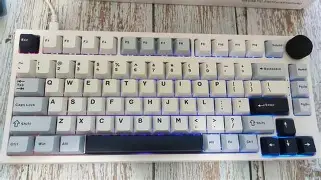
The Magnetic Advantage in Daily Productivity
For the professional writer or developer, the shift to magnetic switches offers a feature known as Rapid Trigger. In traditional switches, a key must travel back up past a reset point before it can be pressed again. Hall Effect sensors allow the key to reset the instant it begins to move upward, no matter how slightly. This means that for users who perform rapid-fire repetitive tasks—such as navigating lines of code or performing complex shortcuts in video editing software—the responsiveness is unparalleled. The V2 specifically improves upon the firmware reliability of previous models, ensuring that these precise measurements remain stable even during high-intensity usage where the keyboard might be subject to heat or slight electromagnetic interference from other laptop peripherals.
Pros and Cons: A Realistic Assessment
- Customizable Actuation: The ability to change how far you need to press a key to register a character is a game-changer for those suffering from repetitive strain injury or those who find laptop keys too "mushy."
- Consistent Acoustic Profile: Thanks to the gasket mount and sound-dampening foams, the board produces a deep, satisfying "thock" sound rather than a high-pitched "tick," making it professional enough for open-plan offices.
- Exceptional Durability: Because Hall Effect switches have no physical contact points that can wear out or corrode, they are rated for hundreds of millions of presses, far outlasting the life of the laptop they are paired with.
- Seamless Multi-Device Connectivity: The V2 supports high-speed 2.4GHz wireless, Bluetooth 5.0, and USB-C wired modes, allowing it to stay paired with a laptop, a tablet, and a desktop simultaneously.
- Rapid Trigger Capabilities: Specifically for those who balance their workday with gaming, the magnetic sensors provide a competitive edge that standard laptops simply cannot emulate.
- Weight and Portability: Unlike a slim laptop, the Tk75He V2 is substantial. Its weight provides stability on the desk but adds significant bulk to a commuter's backpack.
- Software Learning Curve: To get the most out of the Hall Effect features, users must interact with Gamakay's proprietary driver software, which can be more complex than simply plugging in a basic keyboard.
- High Internal Ceiling: The height of the keyboard deck is significantly higher than a laptop's flat surface, which necessitates the use of a wrist rest for optimal ergonomic alignment.
- Battery Management: While wireless performance is excellent, keeping the RGB lighting at maximum brightness will require frequent charging compared to the low-power draw of integrated laptop keyboards.
Comparison: Laptop Decks vs. Gamakay Tk75He V2
To understand why a user would add a pound of hardware to their setup, it is helpful to compare the technical specifications of a standard high-end laptop keyboard against the Tk75He V2.
Discover deals on Laptops & Computers — updated daily.
View Offers →| Feature | Standard Laptop Keyboard | Gamakay Tk75He V2 |
|---|---|---|
| Switch Type | Scissor-switch (Membrane) | Magnetic Hall Effect |
| Actuation Distance | Fixed (typically 1.1mm to 1.5mm) | Adjustable (0.1mm to 4.0mm) |
| Durability | 5 - 10 million presses | 100+ million presses |
| Repairability | Very low (usually requires entire deck replacement) | High (hot-swappable individual switches) |
| Key Travel | Shallow (approx. 1.2mm) | Deep (4.0mm total travel) |
| Feedback | Tactile bump with bottom-out harshness | Linear, smooth travel with gasket cushioning |
Buying Guide: Transitioning from Laptop to Magnetic Keyboard
When considering the switch to the Gamakay Tk75He V2, buyers should evaluate several key factors to ensure the peripheral complements their existing laptop ecosystem rather than complicating it. Not every user requires 0.1mm actuation, and not every desk setup can accommodate a 75% mechanical board.
Assessment of Desktop Space and Ergonomics
The first consideration is physical space. If you are using a 13-inch or 14-inch laptop, the Gamakay Tk75He V2 will be wider than your computer. You will need to decide if you are going to place the keyboard in front of the laptop (requiring a deeper desk) or if you will use a laptop stand to elevate the screen to eye level. The latter is highly recommended. Elevating the laptop and using the Tk75He V2 as the primary input device creates a "pseudo-desktop" experience that significantly improves posture, as it separates the screen height from the hand position.
The Connectivity Matrix
Modern laptops are notoriously stingy with ports. Potential buyers should consider how they intend to connect the V2. While the 2.4GHz dongle provides the lowest latency (crucial for gaming and high-speed typing), it occupies a USB-A port that many modern ultrabooks lack. Using Bluetooth is an option for general productivity, but for those seeking the full benefits of the Hall Effect sensors, a direct USB-C to USB-C wired connection is often the most stable and reliable method for firmware updates and deep customization settings.
Understanding Switch "Feel"
The Tk75He V2 uses linear magnetic switches. For someone coming from a laptop, where there is usually a distinct "pop" or tactile bump when a key is pressed, linear switches can feel "slick" or "slippery" at first. There is no physical bump to tell your finger the key has registered; the registration happens via the sensor. New users should expect a 2-to-3-day adjustment period where they might accidentally double-type or rest their fingers too heavily on the keys, causing unintended inputs. However, once mastered, the smoothness of these switches allows for a much higher "words-per-minute" (WPM) ceiling than traditional scissor switches.
Software Requirements
The advanced features of the Tk75He V2, such as setting the Dynamic Keystroke (DKS) functions—where one key press can perform different actions depending on how deep it is pressed—require the Gamakay software. Buyers should ensure they are comfortable installing third-party configuration tools. If you are using a locked-down corporate laptop where you cannot install software, you will still be able to use the keyboard in its default state, but you will miss out on the granular actuation adjustments that define the V2 experience.
Real-World Use Cases: Why the Switch Matters
The impact of this keyboard is best understood through the lens of specific professional personas. For the **Creative Professional**, such as a video editor using a MacBook Pro or a Dell XPS, the Tk75He V2 allows for the mapping of the "J-K-L" scrub keys to a hair-trigger actuation. This makes fine-cutting footage much more responsive. The dedicated volume knob on the Tk75He V2 also provides a tactile way to adjust audio levels without fumbling for small laptop function keys or screen sliders.
Discover deals on Laptops & Computers — updated daily.
View Offers →For the **Software Developer**, the gasket-mounted typing experience is a revelation. Standard laptop keyboards can feel "stiff" by the end of an eight-hour coding session, leading to Joint stiffness in the fingertips. The "bounce" provided by the Tk75He V2's internal gaskets absorbs the kinetic energy of every stroke, making the act of typing feel more organic and less taxing. Furthermore, the ability to hot-swap switches means that if the user decides they want a different feel for their "Enter" or "Spacebar" keys, they can physically change those individual components without needing to buy a new device.
Finally, for the **Student or Remote Worker**, the board's versatility is its strongest asset. The ability to switch between a laptop for work, an iPad for notes, and perhaps a home gaming console via the Bluetooth/Wireless toggle makes it a central hub for all digital interaction. It eliminates the need for multiple keyboards, decluttering the workspace and ensuring that the user develops a "muscle memory" for a single, high-quality set of keys regardless of the device they are using at that moment.
Natural Conclusion
Transitioning from a built-in laptop keyboard to a specialized Hall Effect mechanical board like the Gamakay Tk75He V2 is a significant step toward optimizing one's digital environment. While laptops have made incredible strides in performance and display technology, the fundamental physical interface has largely remained stagnant due to the constraints of thin-and-light designs. The Tk75He V2 breaks these constraints by offering a level of tactile customization that was previously impossible. Through its adjustable actuation, gasket-mount comfort, and robust connectivity, it addresses the primary pain points of mobile productivity: ergonomic strain, lack of precision, and hardware fragility.
The "switch" mentioned in the title of this article is not just about moving from one set of keys to another; it is about adopting a more intentional approach to how we spend our hours at our screens. Whether it is the satisfying acoustic feedback that makes writing a joy, the rapid-trigger response that enhances competitive play, or the ergonomic relief that protects long-term health, the Tk75He V2 proves that the peripheral is just as important as the computer itself. As more professionals find themselves working from varying locations on various portable devices, having a consistent, high-performance "touch-point" becomes an essential component of a modern workflow. In the case of the Gamakay Tk75He V2, the transition reveals that once you experience the precision of magnetic sensors, going back to the flat, unyielding keys of a standard laptop is a difficult prospect to entertain.